The Last of UST
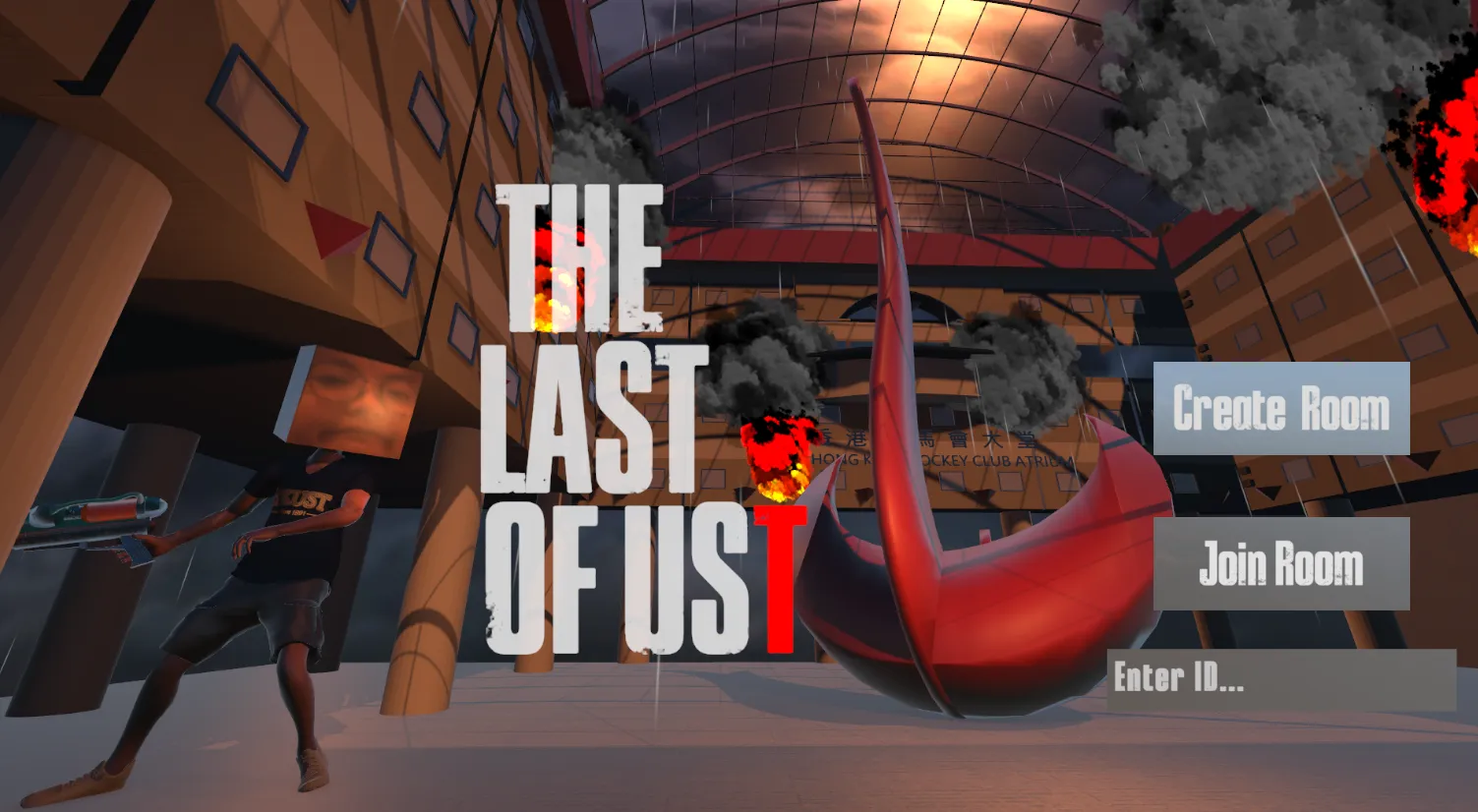
A 4-player co-op party game where tethered players clear a gauntlet of themed stages — parkour, a gravity-flip runner, bomb defusal, and a boss fight — over Steam. My HKUST final year project.
- Unity
- C#
- FishNet
- Multiplayer
- Plastic SCM
Overview
A 3D online co-op game built in Unity, and the team final year project for my degree at HKUST (the name is a pun on The Last of Us). Up to four players join through a Steam lobby and play through a sequence of themed stages — a parkour platformer, a Geometry-Dash-style gravity-change runner, a Keep Talking and Nobody Explodes-style bomb defusal, a WipeOut quiz/elimination round, and a final boss fight. Players are physically chained to one another — the core mechanic is inspired by Chained Together — so every stage is a problem in moving as one rather than alone.
It was built by a team. My work centered on the multiplayer layer, the chain that binds the players, part of the platformer, and stitching everyone’s independently-built stages into one game.
Architecture
The whole game runs as a server-authoritative session on FishNet, with
FishySteamworks as the transport so traffic rides Steam’s networking rather
than raw sockets. A SteamWorkManager wraps Steam matchmaking — create / join /
invite / leave a lobby, propagate the host address, and hand the connection off
to FishNet — so joining a friend’s game is a single Steam invite.
A networked GameManager singleton is the spine. It’s a finite state machine
(PlayingPlatform → PlayingGravityChange → PlayingBomb → PlayingBoss → End) that
owns the connected-player list, the rope tether between players, and the
per-stage setup (cameras, lighting, enabling weapons for the boss fight, firing
the end cutscene). A persistent BootstrapSceneManager drives networked scene
loading — LoadGlobalScenes / UnloadGlobalScenes — so every client
transitions between stages in lockstep. Each hazard (moving, rotating, pushing,
destructible and timed platforms, laser traps, randomly-spawned obstacles) gates
its simulation behind IsServerStarted and replicates to clients, keeping the
world consistent across the session.
My contributions
- Multiplayer implementation. Built the game’s netcode on FishNet —
networked player spawning and movement, and the server-authoritative obstacle
and stage logic using FishNet’s
ServerRpc/ObserversRpcpatterns — running on top of the team’s Steam transport layer. - The chain. Implemented the chain that physically links the players — a Verlet-integration rope simulation with distance constraints, collision handling and GPU-instanced link rendering, plus a server-side pull force that drags a player along when the chain snaps taut. It’s the mechanic the whole game is built around.
- Part of the platformer. Contributed to the parkour stage — player movement and the obstacle/platform hazards that make up the gauntlet.
- Integration & workflow. Wired the separately-built stages into one coherent
networked game loop through the
GameManagerstate machine and the bootstrap scene flow, and set up the team’s source-control and build workflow on Plastic SCM (Unity DevOps), including ParrelSync for testing multiplayer locally.
Stack
Unity (URP) and C#; FishNet for netcode with FishySteamworks + Steamworks.NET / Heathen Steamworks for the Steam layer; Cinemachine, Visual Effect Graph and post-processing for presentation; ParrelSync for local multiplayer testing; and Plastic SCM / Unity DevOps for version control.